The All-on-4 Procedure,
Step by Step
What actually happens on the day, how much it hurts, and how long recovery really takes.
- 4.9 on Google · 800+ reviews
- Dr Jignesh Patel, GDC 81168
- Morden & Surbiton
The short answer
The All-on-4 procedure takes two to four hours per arch. Any failing teeth are removed, four implants are placed under local anaesthetic, and a fixed temporary arch is attached the same day. Most people take painkillers for three to five days and return to normal activity within a week.
The six stages of All-on-4 treatment
Free consultation and assessment
Day 1 · about 45 minutes
We examine your mouth and remaining teeth, talk through what you want to be able to eat and how you want to look, and tell you honestly whether All-on-4 is the right answer for you.
3D CT scan and digital planning
Within 1–2 weeks
A CT scan shows exactly how much bone you have and where it is. We plan the position and angle of each implant digitally before you come in for surgery, so nothing is decided on the day.
Extractions, if any are needed
Same appointment as surgery
Any failing teeth on the arch being treated are removed at the start of the surgical appointment, under local anaesthetic.
Four implants placed and a fixed temporary arch fitted
Surgery day · 2–4 hours
Four implants are placed, two upright at the front and two angled at the back to use the bone you already have. A fixed temporary arch is attached the same day, so you go home with teeth.
Healing and review
About 6 weeks
The implants fuse with your jawbone. You wear the temporary arch throughout and come in for periodic reviews. Most people are back to normal daily life within a week or two.
Your final fixed arch
After integration
Once the implants have integrated we take final impressions and fit your permanent arch, made to the shape, shade and bite we agreed with you.
Wondering how much of this would apply to you?
Send four photos of your teeth and your medical history from your phone. Our clinical team reviews them and comes back within one business day with what your own treatment would involve — free, and with no obligation.
What “teeth in a day” actually means
It means the implants and a fixed arch of teeth go in at the same appointment, so you walk out with a full set of teeth rather than a gap or a denture. It is the fourth of the six all on 4 procedure steps above, and it is the stage everybody asks about first. What it does not mean is that your treatment is finished that afternoon.
The clinical name for it is immediate loading. Ordinarily an implant is left undisturbed beneath the gum for months while bone grows onto its surface, and only then is a tooth attached to it. Immediate load dental implants are given their job straight away. That works with All-on-4 because the four implants are joined by one rigid arch: the arch spreads the forces of speaking and light chewing across all four, so no single implant is rocked loose while it is fusing, and the two tilted back implants engage a long run of solid bone, which is what makes them firm enough to be loaded on the day.
There is a condition attached, and it is worth knowing before you come in. Immediate loading depends on every implant being tight the moment it is placed, which is measured on the day rather than assumed from the scan. Occasionally bone turns out to be softer than the images suggested and an implant will not hold firmly enough to be trusted with an arch straight away. When that happens we tell you at the time and let the implants heal covered over before the arch goes on. That is a delay of a few months, not a failure, and we would far rather have the conversation than load an implant that is not ready. It is an uncommon but genuine outcome of same day teeth implants, and any practice offering the treatment should mention it before you book.
The arch you leave with is fixed. It is screwed to the implants, you cannot take it out, it stays in overnight and it needs no adhesive and no soaking. It is not, however, the arch you will keep. The temporary is made of acrylic, built to look right and to let you speak normally from the first day, and deliberately not built for heavy chewing.
The final arch waits because your mouth is still changing. Swelling settles, extraction sockets fill in, and the gum shrinks back onto a ridge that is remodelling around four new implants. An arch made in the first week would fit a mouth that has stopped existing by the time the implants have integrated. Waiting also gives you several weeks of wearing a full-size trial: if the teeth look too long, the shade is not what you pictured, or the bite feels wrong, it gets changed before the permanent arch is made rather than after.
Does All-on-4 hurt?
The surgery itself should not hurt, because the whole arch is numbed with local anaesthetic before anything begins. The discomfort comes afterwards, and for most people it is soreness, swelling and stiffness for three to five days rather than severe pain.
During the appointment you will be aware of pressure, vibration and the sound of instruments — sensations rather than pain. The anaesthetic is topped up as the hours pass so that it never wears thin, and you can raise a hand at any point and we stop. If it is the length of the appointment rather than the surgery that you dread, intravenous sedation can be added; it leaves most people drowsy, detached and remembering very little of it. Sedation is one of only three things charged on top of the fixed treatment fee, and you will be quoted for it before you decide.
The local anaesthetic wears off two to four hours after you get home, and the sensible move is to take your first dose of painkillers before it does rather than waiting to find out. The first evening is usually the least comfortable part: a deep ache along the jaw, a sense of tightness, and a throb if you lean forward. By the next morning most people describe it as bearable and rather boring instead of painful.
Swelling builds for two to three days before it starts to go down, and it shows more after upper-arch surgery, around the cheeks and under the eyes. Bruising often appears a day or two later, can track down towards the jawline and neck, and turns yellow-green before fading over a week or so. It looks considerably worse than it feels. Ice held against the outside of the face on the first day, and sleeping with your head raised on an extra pillow for the first few nights, both make a visible difference.
For all on 4 dental implants pain, ordinary over-the-counter painkillers are usually enough. Most people use ibuprofen and paracetamol, and we will tell you what to take, how much and how often, having checked it against the rest of your medicines first. Most people have stopped taking anything within three to five days. If we prescribe an antibiotic or a medicated mouthwash, it comes with written instructions rather than a verbal aside on your way out.
We will not tell you the procedure is painless, because it is oral surgery and nobody can honestly promise that. What we can describe is the shape of it: worst on days two and three, clearly improving after that. Pain that is increasing from day four onwards, a sudden sharp throb, a bad taste or a temperature are all reasons to ring the practice rather than wait for your review appointment.
Recovery, week by week
Most people are back to their ordinary routine within a week, and the full all on 4 recovery time — through to the day your final arch is fitted — is about six weeks. The first week is about swelling going down. Everything after that is bone quietly fusing to the implants while you get on with your life.
Days one to three are the low point and are best planned for. Rest, use ice on the outside of the face on the first day, sleep propped up, and start warm salt-water rinses the day after surgery rather than the same evening. Keep off cigarettes and alcohol, avoid drinking through a straw, and leave the gym alone. Eat cool and soft: yoghurt, smoothies taken with a spoon, scrambled egg, mashed potato, soup once it has cooled. Do not skip meals because chewing feels like an effort — healing runs on food.
Days four to seven are when it turns. Swelling drops away, bruising comes to the surface and starts fading, and most people with desk jobs are back at work around day three or four; a physically demanding job is closer to a week. Move on to soft food you can chew gently: flaked fish, pasta, minced meat, well-cooked vegetables. Cut everything small and chew on the back teeth on both sides. Nothing that needs a front-tooth bite — tearing at food with the front of the arch puts a lever on the implants at exactly the wrong moment.
Weeks two to six feel close to normal. Soreness has gone, the gum tightens and firms around the arch, and any lisp settles within a fortnight, faster if you read aloud for ten minutes a day. Exercise can go back to normal at around two weeks. You can eat most things, but the temporary arch is acrylic and will crack under a hard bite, so keep away from crusty bread, nuts, boiled sweets, toffee, ice and whole apples until the final arch is in.
Months three to six are the part you barely notice. The implants integrate with the bone, and there is nothing you have to do beyond cleaning well and coming to your reviews, where we check the arch, the screws and the gum, and take radiographs when they are useful. Once integration is confirmed we take final impressions and fit your permanent arch. Give yourself a fortnight to settle into it: a new bite feels strange before it feels like yours. After that, most people eat normally.
These are typical figures rather than a schedule you are obliged to keep to. Heavy smokers, anyone whose diabetes is not well controlled, and people who needed a lot of extractions on the day all tend to heal more slowly, and we will say so at the planning stage rather than leave you wondering why your second week is not like the one described here.
Looking after your new teeth
Once you are healed, all on 4 implants aftercare comes to about five minutes a day at home plus a hygienist appointment two or three times a year. Nearly all of that effort goes into one place: the join between the underside of the arch and your gum.
That join matters because the arch is not sealed against the gum. A narrow space is left beneath it on purpose so that it can be cleaned, and plaque gathers there exactly as it does between natural teeth. The tissue around an implant has less blood supply and fewer anchoring fibres than the tissue around a tooth, so inflammation left in that space reaches bone sooner than most people expect. Brushing the outside of the arch alone will never reach it.
In practice the routine runs in three parts. A soft brush over every surface of the arch, morning and night, angled towards the gum line. Then a water flosser on a low setting, run slowly along the join from one end to the other, on the cheek side and the tongue side. Then an interdental brush or superfloss threaded underneath wherever the water flosser cannot get square on. The evening pass is the one that counts; the morning one can be quicker. We show you all of it before you go home and check your technique at every review. Most people find the first fortnight fiddly and then stop thinking about it.
At the practice, two or three visits a year is usual once treatment is complete. The hygienist cleans what you cannot reach; we check that the screws are still tight, that the bite has not drifted and that the gum around each implant is healthy, and take radiographs periodically to watch the bone level. Every few years the arch may be unscrewed, cleaned thoroughly underneath and refitted. If you grind your teeth we will make you a night guard, because grinding is the single most common reason an arch chips.
Ring us if the gum around the arch bleeds whenever you clean it, if there is a bad taste or smell you cannot shift, if the bite feels different, or if anything clicks or moves. Caught early, these are small problems with straightforward fixes. Left for a year they are not. This is also the honest catch in All-on-4: it works well for people who will do the daily five minutes and keep the appointments, and it disappoints people who will not.
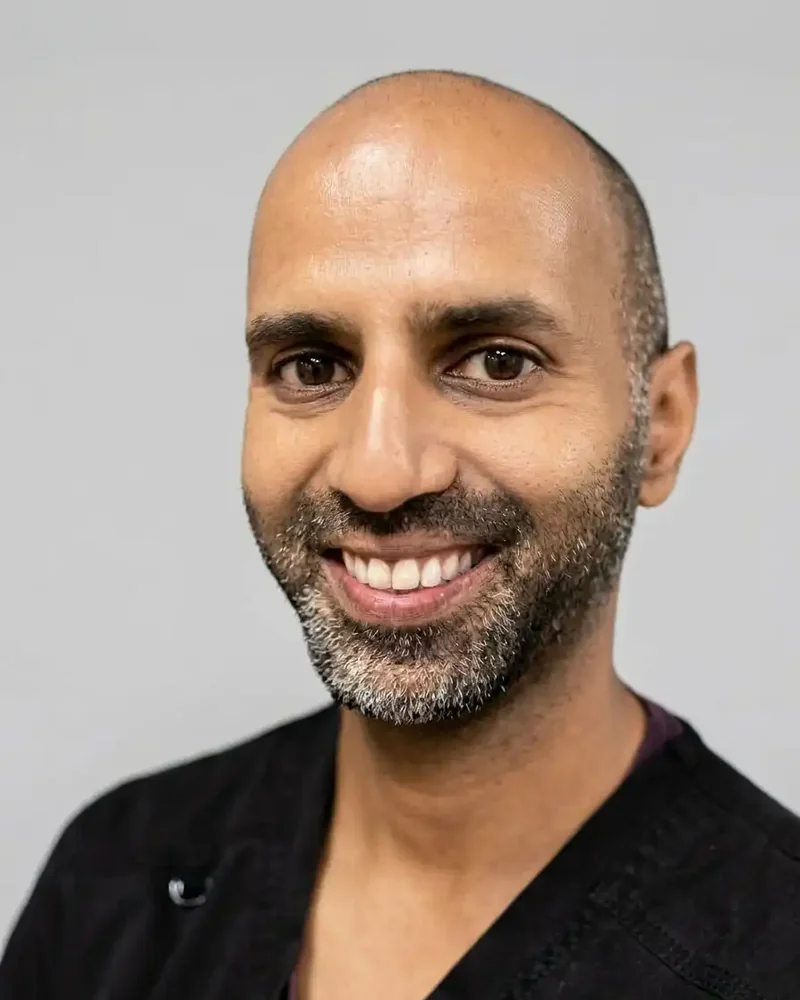
All-on-4 treatment led by Dr Jignesh Patel, Implant Surgeon
GDC No. 81168
Procedure and recovery questions
How long does All-on-4 surgery take on the day?
Can I be sedated for the surgery?
How much time off work will I need?
What is recovery actually like in the first week?
When is the final arch fitted?
What happens at the consultation before I commit to anything?
Who carries out the treatment, and where?
Where we place All-on-4 implants
All-on-4 treatment is carried out at our Morden and Surbiton practices, which are equipped for implant surgery.
ConfiDental Clinic Morden
245 Saint Helier Avenue, Morden, SM4 6JH
All-on-4 patients travel here from: Sutton, Cheam, Carshalton, Wallington, Worcester Park, St Helier, Mitcham.
About our Morden practice →ConfiDental Clinic Surbiton
359 Ewell Rd, Tolworth, Surbiton, KT6 7BZ
All-on-4 patients travel here from: Kingston upon Thames, Tolworth, Chessington, New Malden, Epsom, Thames Ditton.
About our Surbiton practice →Not sure which practice is closer? Ring either one and we will work it out with you. If our Purley practice is nearest, the team there can arrange your consultation and refer you to Morden or Surbiton for treatment.
Keep reading
← Back to the All-on-4 dental implants guide
All-on-4 cost and finance
What All-on-4 costs per arch and for both arches, what the fee includes, and how to spread the cost.
Read moreAm I suitable for All-on-4?
How bone loss, gum disease, smoking, age and wearing dentures affect whether All-on-4 will work for you.
Read moreAll-on-4 vs dentures
An honest comparison against conventional dentures, implant-retained dentures and traditional full-arch implants.
Read moreAll-on-4 questions answered
Twenty-plus questions on cost, recovery, cleaning, eating, maintenance and how long All-on-4 lasts.
Read moreBook your free All-on-4 consultation
Come in for an assessment with no obligation. We will examine your mouth, take a 3D scan where it is needed, explain what All-on-4 would involve for you, and give you a written quote before you decide anything.
Not ready to come in? Start online instead.
Send photos for a free implant assessment